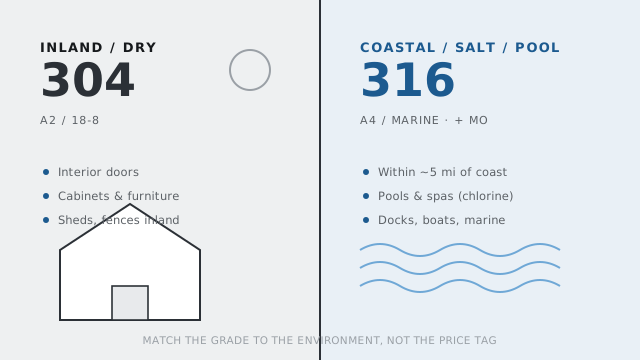
Short answer: Use 304 for indoor and general outdoor jobs in dry or inland climates. Use 316 anywhere near saltwater, in pools, or around chemicals. The only meaningful difference is that 316 contains 2–3% molybdenum, which is what stops pitting in salt.
The one alloy difference that matters
Both 304 and 316 are austenitic stainless steels, both are non-magnetic-ish, and both resist ordinary rust well. The difference is one ingredient: molybdenum. 316 adds roughly 2–3% of it, and molybdenum dramatically improves resistance to chloride attack, the specific kind of corrosion caused by salt and pool chemicals.
Engineers measure this with a number called PREN (Pitting Resistance Equivalent Number). 304 lands around 18–20; 316 lands around 24–28. Higher is better in salt. That gap is the whole story.
| Property | 304 (A2 / 18-8) | 316 (A4 / Marine) |
|---|---|---|
| Chromium | ~18% | ~16–18% |
| Nickel | ~8% | ~10–14% |
| Molybdenum | none | ~2–3% |
| Chloride / salt resistance | Good | Excellent |
| Best environment | Indoor & inland outdoor | Coastal, marine, pool, chemical |
| Relative cost | Baseline | ~20–30% more |
Where 304 fails
304 is excellent value and the right choice for most interior doors, cabinets, and outdoor hardware that is not exposed to salt. Its weak spot is chlorides. Within a few miles of an ocean, 304 starts to show tea staining, a brown surface discoloration, and eventually small pits. The structure usually holds for a long time, but it stops looking like stainless.
When 316 is worth the premium
Pay the extra ~25% for 316 when any of these are true: the hardware is within about five miles of saltwater, it gets splashed by a pool or spa, it is on a boat or dock, or it lives in a chemical or wash-down environment. In those settings 316 is not an upgrade, it is the minimum spec.
The ten-second rule
Ask one question: "Will this hinge ever meet salt or chlorine?" If yes, buy 316. If no, 304 saves you money with no downside. When you genuinely cannot tell, 316 is the safe default, the cost difference on a few hinges is trivial next to the cost of replacing rusted hardware.
Frequently asked questions
Is 316 always better than 304?
For corrosion resistance in salt, yes. But 304 is cheaper and equally durable indoors and in dry climates, so 'better' depends on the job. Paying for 316 where 304 would do is just wasted money.
Can I tell 304 and 316 apart by looking?
No. They look identical. The grade is stamped on the product or listed in the spec sheet, that is the only reliable way to know. If a listing will not tell you the grade, treat it as unknown.
What about 316L?
316L is a low-carbon version of 316 used mainly for welded parts to avoid corrosion at the weld. For ordinary bolt-on or screw-in hinges, standard 316 is fine.