Mostly no, the 304 and 316 grades used for hinges are austenitic stainless, which is essentially non-magnetic. But cold-working (the bending and forming that makes a hinge) can leave them slightly magnetic. A weak pull on a magnet is normal and tells you nothing about quality or corrosion resistance.
Why austenitic stainless is (mostly) non-magnetic
The 300-series grades, 304 and 316, have a crystal structure called austenite that isn't magnetic. That's different from the 400-series (like 410 or 430), which are magnetic. So a quality stainless hinge in 304 or 316 will feel weakly magnetic at most.
Why yours might still stick a little
Forming a hinge, stamping the leaves, rolling the knuckles, cold-works the metal and can transform a small amount of the structure into a magnetic phase. The result is slight, partial magnetism, strongest at the worked edges and knuckles. This is completely normal for formed 304 and 316 parts and doesn't mean the hinge is fake or low grade.
Magnetism is not a quality test
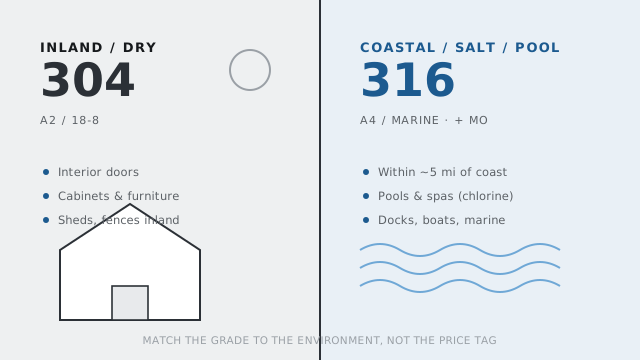
A common myth is that "real" stainless won't stick to a magnet at all. It's not reliable: genuine 304 and 316 hinges often show slight magnetism after forming, and some cheaper stainless is non-magnetic. To judge a hinge, look for the grade stamp (304/A2 or 316/A4) and match it to your environment, don't use a magnet.
Frequently asked questions
Does magnetism mean my stainless hinge will rust?
No. Slight magnetism from cold-working doesn't change the alloy's chloride resistance. Corrosion behavior is set by the grade, 304 vs 316, not by how magnetic the part feels.
How can I tell 304 from 316 then?
Not with a magnet. Look for the stamp (304/A2 or 316/A4), buy from a seller who specifies the grade, and match it to your exposure, 316 near salt or chlorine, 304 inland.