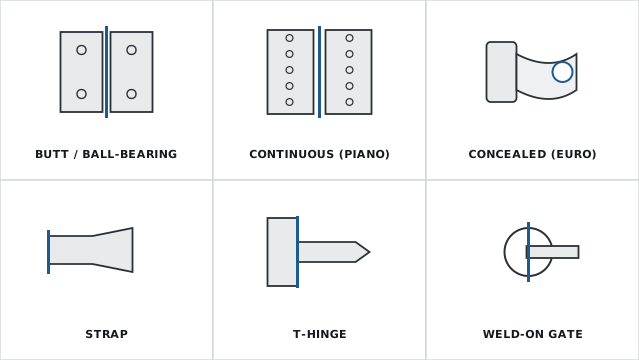
Both spread a door or gate's weight across a long leaf instead of a small butt hinge. A strap hinge has two long leaves; a T-hinge has one long leaf and one short rectangular leaf shaped like a T. The choice comes down to what you're mounting to.
Strap hinges
Two long, tapering leaves distribute load over a wide area, ideal for gates, barn doors, chests, and anywhere both sides of the joint are wide enough to carry a long leaf. On a gate, the long leaves reach across several pickets or boards, spreading the weight so no single fastener is overloaded.
T-hinges
A T-hinge puts its long leaf on the door or gate and its short leaf on the post or frame. That makes it the better choice when the frame is narrow, a gate post or a shed's stile, where a full strap leaf wouldn't fit. The long leaf still spreads load across the gate itself.
Mounting them so they last
- Fasten into solid framing, not just thin pickets or end grain, hit the rails.
- Use enough hinges for the weight, and add an anti-sag cable on heavy gates.
- Match the grade, 304 stainless inland, 316 near salt, and use stainless carriage bolts, not carbon-steel screws.
- Through-bolt heavy gates rather than relying on wood screws.
Frequently asked questions
Which is stronger, a strap or T-hinge?
Neither is inherently stronger, both spread load well. The T-hinge simply fits where the frame side is narrow; the strap hinge suits joints where both sides are wide. Size and grade matter more than the shape.
How do I stop a strap-hinged gate from sagging?
Use enough hinges, fasten into the framing, add a diagonal anti-sag cable or brace from the top hinge corner to the bottom latch corner, and consider adjustable hardware.