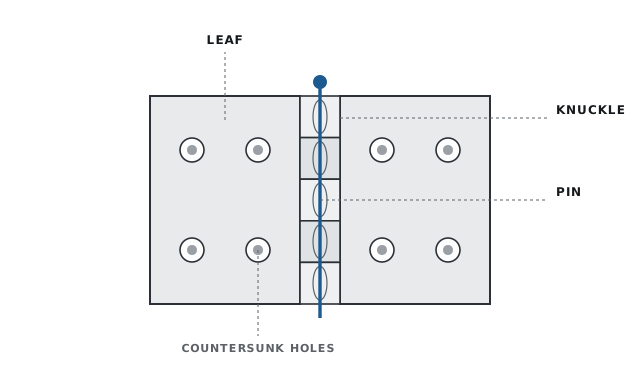
The butt hinge is the plain rectangular hinge on nearly every household door: two leaves joined by a knuckle and pin, mortised into the door edge and jamb so they sit flush. Everything else, ball-bearing, rising, security, is a variation on this basic form.
Anatomy and sizes
A butt hinge is two leaves, a knuckle (the interlocking barrel), and a pin. Size is given as height × width when open. The common sizes: 3.5″ for interior passage doors, 4″ for heavier interior, and 4.5″ for exterior and solid-core doors. Taller, heavier doors take larger hinges and more of them.
Plain vs ball-bearing butt hinges
A plain butt hinge rides metal-on-metal and suits light doors. A ball-bearing butt hinge adds bearings between the knuckles for heavy or high-traffic doors, cutting friction, wear, and squeak. The outward shape is identical; the difference is inside the knuckle.
Choosing one
- Match the size to the door, height by weight, width by door thickness.
- Pick the bearing, ball-bearing for anything heavy or frequently used.
- Pick the grade, 304 stainless inland, 316 near salt or chlorine.
- Add security features, non-removable pins on out-swing exterior doors.
Frequently asked questions
What size butt hinge do I need?
Match the door: 3.5″ for standard 1⅜″ interior doors, 4.5″ for 1¾″ exterior and solid-core doors. When replacing, copy the existing hinge's height, width, and screw pattern.
Do butt hinges have to be mortised?
Standard ones do, they sit in a shallow recess so the leaf is flush with the wood. No-mortise (surface-mount) butt hinges exist for lighter applications where you can't cut a recess.