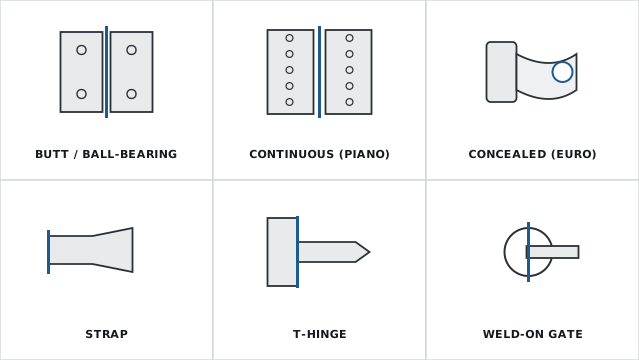
What to look for
Cut-to-length vs fixed
Continuous hinges come in long lengths you cut down, or pre-sized. Measure your joint and allow for trimming.
Material grade
Stainless 304 for general use, 316 for marine. Aluminum and brass versions exist for light or decorative work.
Knuckle and pin
A continuous pin and tight knuckles give smooth, rattle-free motion along the whole length.
Hole pattern
Pre-drilled, countersunk holes save time; weld-on versions suit metal fabrication.
Continuous (piano) hinge selection
| Use | Spec | Notes |
|---|---|---|
| Toolbox / chest lid | Light-gauge stainless | Cut to length. |
| Bench / table leaf | Medium-gauge | Even support along the edge. |
| Full-height door / gate | Heavy continuous | Spreads load, no sag. |
| Marine locker / hatch | 316 continuous | Salt resistance. |
Our picks by use case
304 Stainless Continuous (Piano) Hinge, 1.5″ x 36″, Made in USA
A 304 stainless continuous hinge with pre-punched countersunk holes and stainless screws included. Cut to length with a hacksaw. Spreads load evenly along lids and long doors so nothing warps or sags.
Check price on Amazon →Affiliate link, we may earn a commission at no cost to you.304 Stainless Continuous Hinge, 12″ x 2″ (4-pack)
Shorter 304 stainless continuous hinges for boat lockers, hatches, and lids, polished finish, sold in a 4-pack. For permanent salt immersion, look for a 316 continuous hinge instead.
Check price on Amazon →Affiliate link, we may earn a commission at no cost to you.Common mistakes to avoid
- Choosing too light a gauge for the load, so the leaf flexes.
- Not ending the cut on a knuckle, leaving a weak overhang.
- Under-screwing, piano hinges need fasteners along the full length.
- Using plated steel in damp or marine settings instead of stainless.
Frequently asked questions
Can I cut a piano hinge to length?
Yes, measure, then cut through a knuckle (not a leaf-only span) with a hacksaw or cutoff wheel and deburr. Cutting mid-knuckle keeps the pin captive.
Why choose a continuous hinge?
It distributes load along the entire edge, so nothing sags or racks, ideal for lids, long doors, and anything that must stay dead-straight.
When is a piano hinge better than butt hinges?
When you need even support along a long edge, want to prevent warping on a lid, or need a clean continuous line, toolboxes, benches, fold-down panels.
Can I cut a continuous hinge to length?
Yes, most are designed to be cut. Use a hacksaw or metal-cutting blade and deburr the ends.